
NZ hub
Casino Games NZ: Pokies, Live Tables & Game Guides
Find a game you want to play, get to know its rules and mobile controls, then browse our featured casino offers.
Explore NZ casino games →Casino game notes, New Zealand
How progressive jackpot contributions, starting seeds and game RTP fit together. The examples use dated provider documents, with separate checks of current NetEnt pages and New Zealand’s licensing timetable on 15 September 2026.
Reading the figures. The game-sheet tables below describe particular historical configurations. They are not predictions of a personal return or a current NZ game catalogue. The section on New Zealand law explains the rules for future licensed platforms separately from those older technical examples. 18+.
In the contribution-funded examples below, part of qualifying stakes goes towards the jackpot or its reserve. A displayed meter can include an opening seed as well as later contributions, so it is not simply the amount collected since the last winner.
A game’s published RTP may include a progressive component as well as ordinary wins. To compare two figures, first establish whether both include the same components and refer to the same version. RTP is a long-run theoretical average; it does not predict what one account or session will receive.
Divine Fortune illustrates the difference: its older sheet gives totals with and without the Mega progressive. Comparing only the larger total with a non-jackpot game can hide how much of the stated return depends on a rare jackpot outcome.
The Divine Fortune sheet used in the September 10 research is version 1.2, dated 6 December 2016. It separates the following RTP components; these are the document’s configuration, not a claim about every current casino installation.
| Line as printed | Return |
|---|---|
| RTP with progressive | 96.59% |
| RTP without progressive | 92.52% |
| Main game | 58.62% |
| Free spins | 17.11% |
| Bonus | 16.78% |
| Minor jackpot (inside the bonus line) | 4.51% |
| Major jackpot (inside the bonus line) | 2.98% |
| Mega jackpot | 4.07% |
The rounded components need care. 9.29+4.51+2.98=16.78 for the bonus line. Main game 58.62, free spins 17.11 and bonus 16.78 total 92.51, while the sheet reports 92.52 without the progressive. Adding 4.07 to the reported 92.52 gives 96.59; adding it to the rounded component sum gives 96.58. The 0.01-point difference is consistent with rounding, not an exact reconciliation of the displayed components. NetEnt’s Divine Fortune page still lists 96.59% at the September 15 check.
In that sheet, the Mega is the progressive tier. Minor and Major are fixed prizes within the bonus component, with stated caps of €2,000 and €10,000. Their RTP shares should not also be added as progressive contribution. The Mega’s 4.07 percentage points are a return component, not necessarily the percentage of each stake added directly to the visible meter.
The separate Divine Fortune Gold page, checked September 15, describes a 3.7% stake contribution, with 20% of that contribution reserved for the next jackpot. That is 0.74% of the stake in reserve and 2.96% for the current pool. It says the next Mega starts at €10,000 plus the reserved contribution. This resembles the reserve mechanism in the 2016 sheet, but Gold is a different game: its current page lists 96.63% RTP, not Divine Fortune’s 96.59%.
A game title alone may not identify its RTP configuration. Some suppliers offer operators more than one base-return or jackpot option, so the published rules for the actual version matter.
The Red Tiger presentation used in the September 10 study is dated 9 August 2018. Its configuration grid gives the following options; it is a historical product example, not a current menu for every Red Tiger title.
| Base return | Jackpot contribution offered on top |
|---|---|
| 90% | +1, +2, +3, +4, +5 or +6 percentage points |
| 91% | +1 to +5 |
| 93% | +1, +2 or +3 |
| 95% | no jackpot version offered |
| 96% | no jackpot version offered |
In this 2018 grid, the 90% base option can be paired with between 1 and 6 percentage points of jackpot contribution; the 95% and 96% rows have no jackpot option. The presentation discusses operator tax exposure as a reason for configuration choice. That does not establish the options available on a current game or the configuration selected by a particular casino.
So when two casinos list the same jackpot title, the configuration underneath can differ, and one player's figure need not be another's.
The participating platforms, stake contributions, starting seed and time until a trigger all affect a progressive pool. The specification distinguishes a local jackpot from one shared across a network; the name alone does not.
The Mega Fortune sheet dated 19 December 2016 marks Rapid and Major as local, with liability assigned to the licensee, and Mega as pooled, with liability assigned to the supplier. The Divine Fortune sheet used in the same research marks its Mega as local. These are the recorded configurations, not a guarantee that every later version uses the same arrangement.
The separate non-pooled Guinness entry cited in the September 10 research records €8,636,041.54 on Arabian Nights at Paf.com on 23 November 2012, from a €5 stake. Its explanation describes a server in Åland and contributions from Paf.com customers. That is a dated example of a restricted pool, not a freshly verified claim about the latest non-pooled record.
Mega Fortune’s 2016 sheet reports 96.6% total RTP and rounded components of 62.8% main game, 16.8% free spins, 9.3% bonus and 7.6% jackpots. Those displayed components add to 96.5%, not 96.6%. The three non-jackpot components sum to 88.9%; subtracting the reported 7.6 from 96.6 gives 89.0. Treat the result as about 89%, with a rounding difference, rather than an exact reconciliation.
“Must drop” specifies a bound on a jackpot award; it does not, on its own, disclose the algorithm. The Red Tiger documents used in the original research describe rising trigger probabilities for timed and ceiling jackpots. That should not be generalised to every supplier’s implementation.
The 2018 Red Tiger presentation distinguishes three configurations:
| Type | Prize | Trigger odds |
|---|---|---|
| Progressive | Accumulating | Fixed |
| Timed | Accumulating, time bound | Increase as the deadline approaches |
| Ceiling | Accumulating, money bound | Increase as the cap approaches |
In that presentation, the ordinary progressive has fixed trigger odds; timed and ceiling versions increase the trigger probability towards their bound. The January 2020 explainer also says a timed jackpot can fall earlier. Those descriptions do not supply a player’s exact win probability or a profitable time to play.
The January 2020 explainer described operator-set timeframes and no requirement to stake the maximum. It reported typical Daily Drop awards of £40,000–£50,000 and a then-record £78,429 at Betsson on 24 September 2019. These are historical figures, not today’s prize range or eligibility conditions.
In that historical account, Red Tiger traced the idea to a request around UEFA Euro 2016. This is the company’s account of its product, not proof that it invented every timed-jackpot mechanism.
The configurations examined here restart from a seed rather than zero. Their documents describe reserves built from contributions, but that does not establish the funding arrangement for every progressive jackpot.
The Red Tiger 2018 parameters describe a reseed reserve that receives part of the contribution until full. The Divine Fortune document calls its reserve a “baby” jackpot. The current Gold page also describes reserving 20% of the 3.7% contribution; this is 20% of the contribution, not 20% of the full stake.
The 2016 Divine Fortune footnote says its €10,000 default seed is included in RTP. For that configuration, the seed must not be counted again as an extra return on top of the published percentage.
The sources in the original study give different seeds for different products: Games Global’s WowPot announcement states €2 million; the cited Playtech announcement gives €100,000 for Age of the Gods’ Ultimate Power tier. The 2016 NetEnt sheets give €10,000 for Divine Fortune’s Mega and 50 and 5,000 for Mega Fortune’s lower tiers. Keep each amount with its game, currency or unit, configuration and source date.
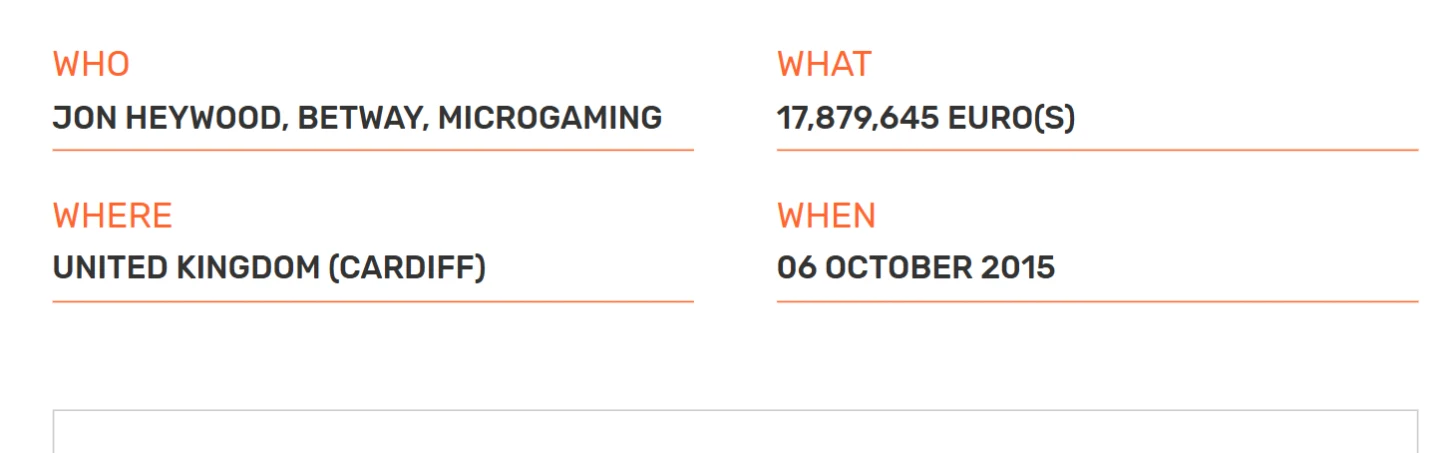
The public Guinness record page lists Jon Heywood’s 2015 Mega Moolah win at €17,879,645. Guinness warns that record changes are not always published immediately, so that page alone does not prove the latest world record remains unchanged.
Games Global’s 4 January 2024 announcement reports a larger WowPot award on Wheel of Wishes on 20 December 2023: €38,461,200.95 or its currency equivalent. A supplier’s payout announcement and a public Guinness entry are different records. The absence of the larger award from that Guinness page does not prove it was never certified.
The original research noted a currency discrepancy: Microgaming’s October 2015 announcement reported £13,213,838.68 and €17,879,645.12, while the Guinness page lists £13,209,300 and €17,879,645. The sterling figures differ by £4,538.68. Without the conversion workings, it is not possible to attribute that difference to a particular exchange-rate or back-conversion method.
The public Guinness page does not identify eCOGRA as the body ratifying that record. That is a limit of the cited page, not proof that no separate audit took place.
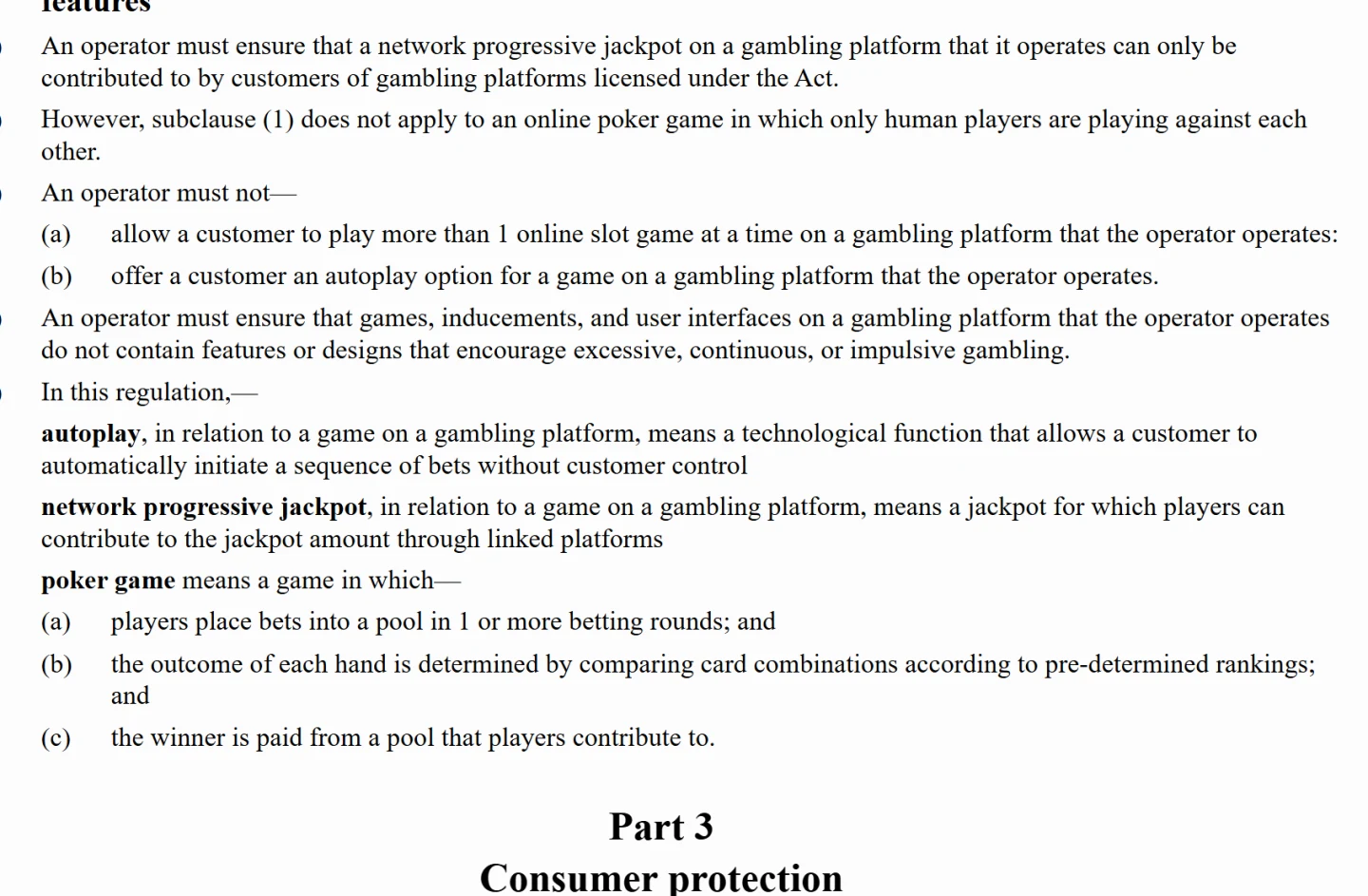
The regulations took effect on 3 July 2026. Under regulation 14, a network progressive on a licensed platform may receive contributions only from customers of platforms licensed under the Act. The regulation makes an exception for online poker played solely between human players.
A pool receiving contributions from unlicensed platforms would not meet that requirement. The rule concerns the licensing of participating platforms; it is not simply a statement about each player’s nationality. Nor does it specify future prize sizes. The number of eligible platforms, contributions, seeds and trigger rules will affect the pools that operators offer.
The original research cited Games Global’s Ontario-specific Maple Moolah as an example of a restricted network. Such arrangements show that a jackpot can operate within a defined market. They do not establish the products, seeds or pool sizes that will be offered under New Zealand’s licences.
The same regulation prohibits autoplay on a licensed platform and allowing a customer to play more than one online slot game at a time on that platform. It also addresses game, inducement and interface features that encourage excessive, continuous or impulsive gambling. It does not establish a cross-operator limit on every device a person uses.
For Mega Moolah, confirm the RTP, jackpot tiers, contribution rates and starting amounts in the rules for the version on your account. The materials reviewed here do not verify a complete set of those figures. WowPot’s published €2 million seed belongs to WowPot and cannot be used as Mega Moolah’s starting amount.
A statement that a jackpot can be won at any qualifying bet size does not establish that every stake has the same chance. Check the game’s eligibility and trigger rules before drawing that conclusion. For Age of the Gods, confirm whether a quoted return includes the jackpot component; figures that add up are not, by themselves, a verified game specification.
The Online Casino Gambling Act 2026 received assent on 28 April 2026 and took effect on 1 May, with later commencement dates for specified provisions. The legal text, rather than a trade report’s summary, is the source for those dates.
The licensing process permits up to 15 licences, with limits on common control. DIA’s provider update of 15 September says eligible auction participants have been notified and the auction will take place on 29 September 2026. Full applications are expected in October; the licensed regime is expected during 2027. A bidder wins the right to apply, not an automatic licence.
The transition in Schedule 1 of the Act applies to providers operating when the Act commenced. If an eligible provider applies before 1 December 2026, the operating exemption ends on the earlier of the day after notice of the licence decision or 1 June 2027; otherwise it ends on 1 December. Advertising is separately restricted. These operating rules are directed at providers and do not themselves make an adult customer’s ordinary play the offence described in section 66, which concerns gambling on behalf of an under-18.
Inland Revenue’s prize-money guidance distinguishes generally non-taxable prizes from winnings connected to a taxable activity. Its examples do not settle every person’s offshore casino tax position; the circumstances of the activity matter.
A jackpot’s funding and RTP describe a statistical model. They do not make the advertised prize likely for an individual, or turn a countdown into a reason to continue a session.
Free, confidential help is available in New Zealand through the Gambling Helpline on 0800 654 655, or by texting 8006. Safer Gambling Aotearoa publishes self-help tools and information for family and whānau. There is no national online self-exclusion scheme covering offshore sites; licensed operators will be required to offer self-exclusion once licensing begins. 18+.
The 2016 NetEnt sheets were located on a third-party mirror in the original research and retain their original dates here. Their rounded components do not reconcile exactly, as explained above. The September 15 update separately checked the live Divine Fortune and Gold pages, official NZ legislation and DIA’s new timetable. The older Red Tiger examples remain dated 2018 and 2020; they are not presented as a new test of current software.
Keep exploring

Not necessarily. Compare the same RTP components and game versions. The 2016 Divine Fortune sheet reports 96.59% including its Mega progressive and 92.52% without it; the rounded components differ by 0.01 point. Those historical figures do not establish the return of every current jackpot game.
Regulation 14 limits contributions to a network progressive on a licensed platform to customers of platforms licensed under the Act, with an exception for human-versus-human poker. It prevents mixing in contributions from unlicensed platforms; it does not specify future jackpots, prize sizes or each contributor’s nationality.
A seed is the starting amount after a jackpot resets. The dated NetEnt and Red Tiger examples describe reserves funded from contributions. Divine Fortune Gold currently describes a €10,000 starting amount plus the reserved contribution. Other products can have different funding and reset rules.
The 2026 Act’s operating and advertising restrictions are aimed at providers and advertisers. Section 66 concerns gambling on behalf of someone under 18; it begins on December 1, 2026. The provider’s authorisation and the account’s protections remain separate questions; this is not a legal conclusion about every possible activity.